

ADVERTISEMENT:
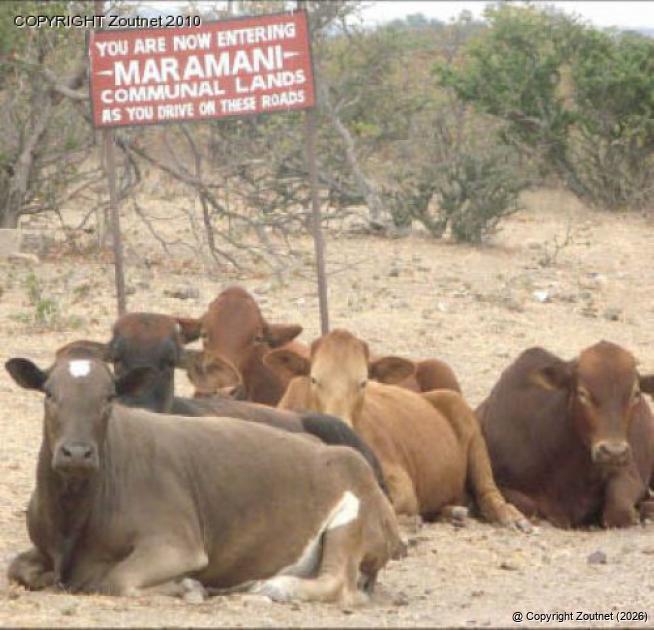
Some of the villagers´ cattle at the Maramani area outside Beit Bridge. The villagers are accusing Botswana game rangers of detaining and poisoning the cattle when they stray into that country. Photo supplied.
Botswana rangers accused of starving cattle
News Date: 24 September 2010
Villagers in the Shashe area of Maramani outside Beit Bridge are accusing game rangers from neighbouring Charter Game Reserve in Botswana of detaining and poisoning their cattle, which would have strayed into that country.
Shashe is situated at the border with Botswana and local villagers’ cattle stray into that country in search of greener pastures.
One of the affected villagers, Mr Samson Tlou, said he lost six heads of cattle last month after the animals had reportedly strayed into Botswana. “Our cattle stray into the Botswana side where they are subsequently spotted by game rangers at Charter Game Reserve, who then detain them for weeks. They do so in an effort to starve them and you will find that on being released some of the animals die along the way while others are attacked by lions in the park,” he said.
Tlou said this had been going on for months, saying they were now appealing to the relevant authorities to address the problem as a matter of urgency.
Another villager, Mr Kenny Ndou, said: “At times, our cattle are fed the leaves of some poisonous plant by the Botswana game rangers, resulting in their dying as they cross back. We are really concerned about this development, which needs the attention of government. The Botswana authorities are saying our cattle spread foot-and-mouth disease, but somehow they then make it difficult for us to cross over and drive the cattle back. Once the Botswana police find you, they detain you and deport you through the Plumtree Border Post. You are then left with a huge expense to travel back home by bus,” he added.
A livestock specialist from the local department of livestock production, Mr Tatenda Nyashanu, also confirmed the latest development. “We continue to receive such reports from villagers in Shashe and surrounding areas who lose their cattle when the animals stray into the Botswana side,” he said.
Shashe, which is situated in the Maramani area, falls under the Greater Mapungubwe Trans-frontier Conservation Area (TFCA), a vast safari land, which is jointly owned by Botswana, South Africa and Zimbabwe. The three governments have since signed a memorandum of understanding aimed at harmonising tourist attractions found within the area.
Meanwhile, farmers at the Shashe Irrigation Scheme are appealing to the local parks and wildlife authority to assist in driving away quelea birds, which continue to cause havoc in the fields by destroying crops. “We are forced to spend the whole day in the fields in an effort to scare away quelea birds, which are a big threat to our crops, particularly wheat,” Mr Isaac Tlou, a farmer.
Quelea birds are regarded as pests by farmers because they can eliminate fields in a short period of time. They normally move in thousands and a huge flock of these birds strips a field of millet, sorghum, or other cereal crop with scarcely a grain left behind. Wild grasses and cultivated wheat crops are highly attractive to them.
Written by
Mashudu Netsianda
Mashudu Netsianda is our correspondent in Beit Bridge, Zimbabwe. He joined us in 2006, writing both local and international stories. He had worked for several Zimbabwean publications, as well as the Times of Swaziland. Mashudu received his training at the School of Mass Communication in Harare.

ADVERTISEMENT: