

ADVERTISEMENT:
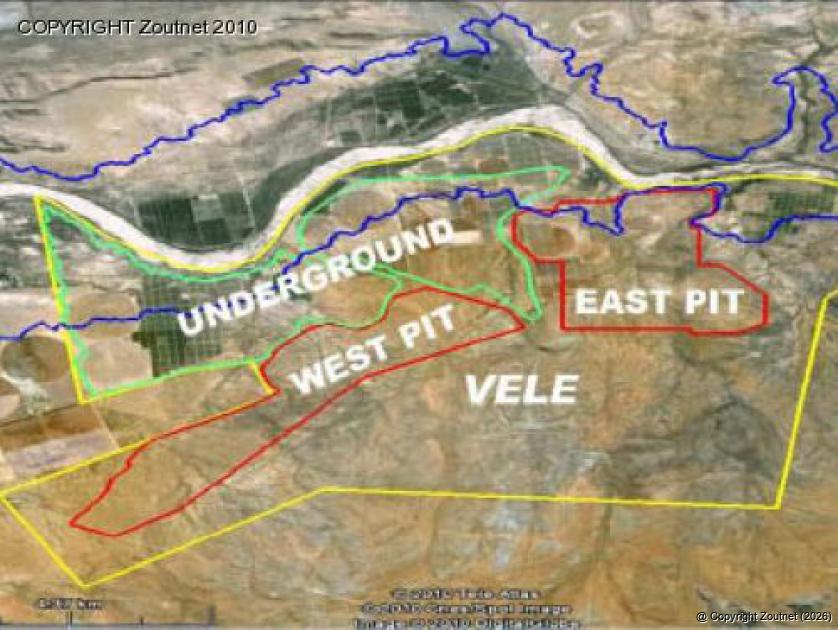
An aerial photo of the Vele Colliery project area. Coetzee, Vele’s general manager, said that as the one open-cast pit is depleted, it is closed and rehabilitated while the next open-cast pit is sunk. Pictured are the two open-cast pits and the underground mining section. The blue line is the 100-year floodline. Photo supplied.
Who is going to fill the last hole?
News Date: 17 December 2010
“We want to show South Africa that responsible mining can co-exist with agriculture, environment, heritage and the community,” said Mr Mark Coetzee, general manager of the Vele Colliery of the mining company, Coal of Africa.
Coetzee was the guest of the Soutpansberg Chamber of Commerce and Tourism that is currently on a fact-finding mission concerning the controversial Vele project of CoAL that was stopped in its tracks by the Department of Environmental Affairs (DEA).
“The science of mines today is very different from the years past. Vele will leave the earth in a better condition than we found it. The impact truly will be about zero. CoAL has a commitment towards restoring and rehabilitating affected areas,” Coetzee said at the meeting held on December 9 at the Yonder Hall in Louis Trichardt.
In his presentation, Coetzee explained the mitigation measures to reduce the impact of the mine on the environment, including vegetation, visibility, dust, noise, archaeology and surface and ground water. A full weather station will be established. The mine combines open-cast and underground mining methodology and has opted for the 50% more expensive open-cast truck-and-shovel method to lower visible impact.
Coetzee says that once a pit´s resources have been depleted, it is closed and rehabilitated while the next open-cast pit is sunk.
“The hole is therefore moving. The biggest scar at any one given time is 60 to 70ha, whereas the total open-cast area is 1 835ha. When you drive on the road past the mine, you cannot see it. We integrate and rehabilitate as the hole moves.”
Mr Fritz Ahrens of the agricultural sector said the undertakings sounded promising but asked who was going to close the last hole. Ms Jana Smith of the chamber agreed with the question and said that they wanted to leave a legacy to their children in 25 years´ time, when Vele’s current project manager would long since have retired.
“There is not going to be a hole. When we have finished, the landscape will look as it was or even better. CoAL won’t just pack up and leave. In terms of legislation, the days are over when you can just pack up and go. And even if the shareholders change, the policy and rules do not,” Coetzee said.
This year, strong opposition from a consortium of environmental groups came against CoAL’s Vele project, situated near the Mapungubwe Heritage Site. The pressure that came from the groups played a role in getting the DEA to halt the project, and in some circles it was called a “green victory” and an example of what could happen if interested groups stood together.
“We invite the public and our environmental opposers to police us to get the best practices on the ground,” Coetzee said.
On why CoAL chose to mine in that sensitive area, Coetzee said that Vele is on the eastern, farmost side of where the coking coal field lies and that Vele is not in the world heritage buffer zone. He said that Vele’s western point is 7km away form the southeastern fence of Mapungubwe and 20km away from Mapungubwe hill. “When you stand on Mapungubwe hill, you cannot see the mine due to the mine lying in the lowest depression,” Coetzee said.
Concerning the threat of acid mine drainage (AMD) it was said that due to the low rainfall and high carbonate contents, the potential for acid mine drainage at Vele was low.
The audience heard that Coal of Africa Limited is not a purely Australian company as is often thought. CoAL is a multi-listed public company, also listed on the London Stock Exchange. "CoAL has South African shareholders as well; you can also become a shareholder,“ Coetzee said.
With reference to the fact that the DEA stopped the mine, Dr Harold Braack, CoAL’s environmental specialist, said that Vele got caught between two departments. Braack commended the mine’s openness to have environmentalists, NGOs and farmers police them.
Written by
Linda van der Westhuizen
Linda van der Westhuizen has been with Zoutnet since 2001. She has a heart for God, people and their stories. Linda believes that every person is unique and has a special story to tell. It follows logically that human interest stories is her speciality. Linda finds working with people and their leaders in the economic, educational, spiritual and political arena very rewarding. “I have a special interest in what God is doing in our town, province and nation and what He wants us to become,” says Linda.

ADVERTISEMENT: