

ADVERTISEMENT:
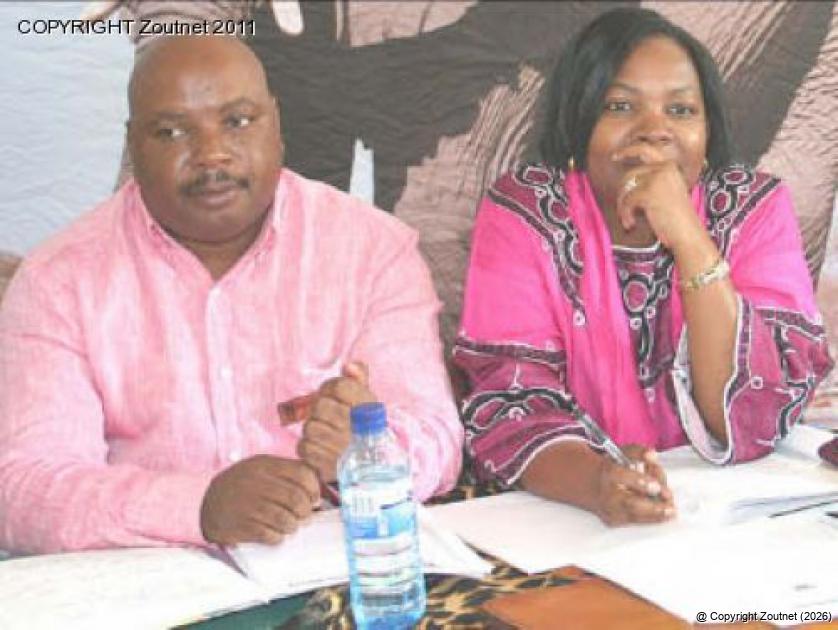
Makhado Municipality’s municipal manager, Mr Shadrack Tshikalange (left), and the municipal mayor, Cllr Mavhungu Lurule, at the integrated development plan consultative meeting hosted on February 25 at the show hall.
Delegates walk out of IDP meeting
News Date: 11 March 2011
Resistance is building up because of the Makhado Municipality’s custom to conduct meetings in Tshivenda only. This and other habits, such as never answering letters and shunning communication, infuriate important stakeholders including organised agriculture.
The language question at meetings where different cultural groupings attend is normally solved by using English or at least giving intermittent summaries in English.
At the integrated development plan (IDP) consultative meeting, hosted on February 25 at the show hall, delegates of some organisations walked out because no English was spoken and they could not follow the procedures or participate. “One sentence of welcome was spoken in English and that was the last of it,” said Ms Aretha Smith, secretary of the Soutpansberg Ratepayers Association, who also walked out.
Organised agriculture expressed its deep disappointment after the IDP meeting.
“The meeting started 20 minutes late. Councillor Baloyi led the meeting and refused to speak Afrikaans or English. Thirty minutes after the onset of the meeting, our representatives walked out because it is ridiculous to attend a meeting which is inaccesible in terms of language,” Mr Stephen Hoffman, chairperson of the Soutpansberg District Agricultural Union (SDAU), said. Hoffman said that language rights were protected in the Constitution of South Africa and that the local government was crushing that right and ignoring it on purpose.
The Makhado Municipality afterwards confirmed that their policy is that all 11 South African languages are official and recognized. “It is just unfortunate that some few people left the meeting, claiming linguistic cleavage,” the municipal spokesperson, Mr Louis Bobodi, stated on March 7.
Bobodi was asked to say more clearly why no English was used.
“I am not aware that there was no English. But as indicated, we use all 11 South African official languages without discrimination,” Bobodi answered. Because of the language exclusion, the SDAU placed it on record in a letter to the Makhado Municpality that the IDP meeting is not accepted by them as a lawful meeting.
“The budget of the Makhado Municpality for the 2011/2012 financial year is also rejected by the SDAU, unless consultation with this office takes place according to appropriate legislation,” Hoffman said. The agriculture union followed up with a full explanation to the municipality of why the union reject the 2011/2012 IDP.
“In the IDP documents it is stated that the main purpose of the IDP is, among others, ‘to encourage involvement of all communities’. It is put on record that this is not true. During the past 10 years the Makhado Municipality refused to consult with organized agriculture. Year after year, letters to this effect were forwarded to the municipality and NOT ONCE was acknowledgement of receipt received,” Hoffman said. He added that, apart from the fact that organized commercial agriculture was not consulted, its needs were practically excluded from the IDP. This despite the fact that organized commercial agriculture is one of the biggest job creators in the municipal area.
“It is unconstitutional and seems to be foolish not to include commercial agriculture in its consultation process,” Hoffman said.
Written by
Linda van der Westhuizen
Linda van der Westhuizen has been with Zoutnet since 2001. She has a heart for God, people and their stories. Linda believes that every person is unique and has a special story to tell. It follows logically that human interest stories is her speciality. Linda finds working with people and their leaders in the economic, educational, spiritual and political arena very rewarding. “I have a special interest in what God is doing in our town, province and nation and what He wants us to become,” says Linda.

ADVERTISEMENT: