

ADVERTISEMENT:
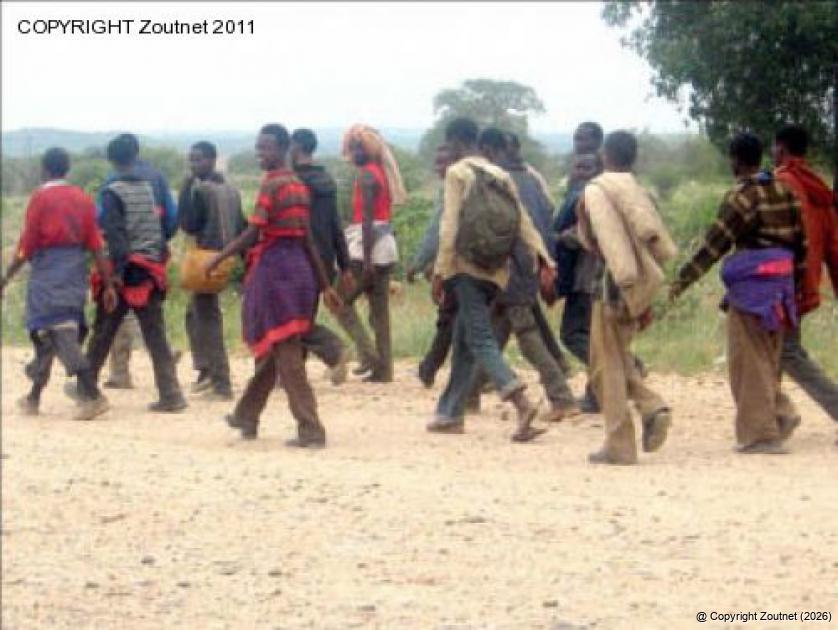
Stranded Somali refugees head to an unknown destination soon after they were denied entry into South Africa by Home Affairs officials on Friday.
Somalis denied entry into SA
News Date: 06 May 2011
Several Somali refugees, who intended to cross into South Africa, are stranded at the Beit Bridge border post, after South African home affairs officials at the border denied them entry into the country.
Nearly 100 Somalis, who intended to apply for asylum permits, were turned away at the entry port on Friday and they are now stuck in Beit Bridge. However, some of them managed to get to Musina after resorting to border jumping into South Africa.
They use Zimbabwe as their transit point to South Africa, after having entered that country through the Nyamapanda Border Post.
Zimbabwean health authorities in Beit Bridge have now raised fears of a possible disease outbreak in the border town. The local district environmental health officer, Mr Notho Dube, said they had admitted 10 Somalis to the Beit Bridge District Hospital after they had contracted malaria, adding that there was a need to address the situation to avoid a possible outbreak urgently.
The local regional immigration manager in charge of Beit Bridge Border Post, Mr Charles Gwede, said the people were denied entry by the South African immigration authorities after failing to produce the required documents from their previous host country. The refusal of entry by the South African authorities follows the recent amendment of the immigration laws, which was effected on 29 April.
In the past, refugees were allowed into South Africa without any form of documentation after which they would then apply for asylum permits after entering the country. “As a normal procedure, we cleared the Somali refugees and they proceeded to the South African side, where they were denied entry before coming back to Zimbabwe, and they are now stranded in Beit Bridge. In fact, when we engaged our South African counterparts, they indicated to us that, with effect from 29 April, they were no longer accepting refugees without referral documents from the previous host country of safety, in line with their new immigration laws,” he said.
“Most of the Somali refugees are undocumented, yet they are supposed to have referral clearance letters from the first country of safety before they can proceed to the next country, and it looks like immigration laws were being flouted.”
Gwede said they were now in the process of engaging partners, such as the International Organisation for Migration (IOM) and the United Nations High Commission for Refugees (UNHCR), to assist in ferrying the Somalis to a local refugee camp in the Chipinge area.
Meanwhile, Beit Bridge stakeholders held an urgent meeting on Tuesday to explore ways aimed at addressing the situation in the border town. The meeting, which was chaired by the local district administrator, Mr Simon Muleya, involved the police and officials from the local Immigration Department, Social Services, IOM and the Department of Health.
Stakeholders agreed that they would offer the refugees temporary shelter where they would be provided food and medication while waiting to be taken to the camp.
The refugees have resorted to begging for food handouts from locals and travellers passing though the border. Some of them are also in bad health. During the meeting, it was also noted that most of the refugees were shunning assistance and opting to cross the border into South Africa illegally.
Written by
Mashudu Netsianda
Mashudu Netsianda is our correspondent in Beit Bridge, Zimbabwe. He joined us in 2006, writing both local and international stories. He had worked for several Zimbabwean publications, as well as the Times of Swaziland. Mashudu received his training at the School of Mass Communication in Harare.

ADVERTISEMENT: