

ADVERTISEMENT:
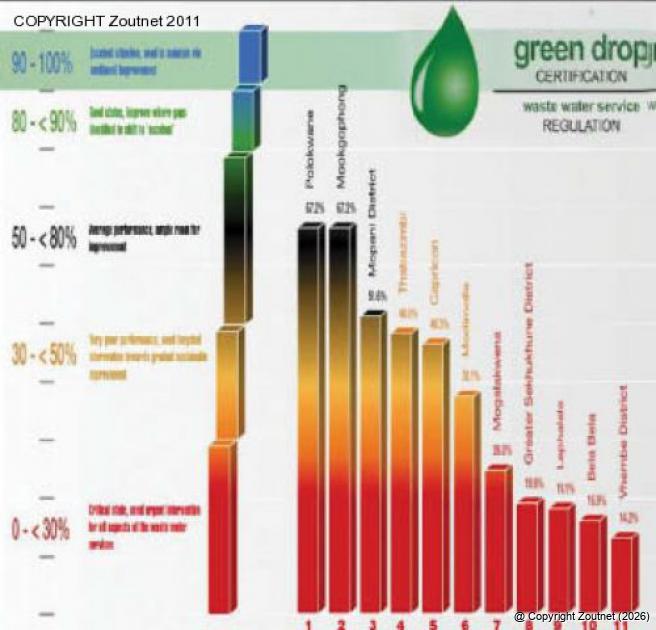
The province’s overall performance in the different district municipalities (Graphic: DWA Green Drop Report).
Report labels Vhembe the worst municipality
News Date: 22 July 2011
The Vhembe District Municipality is the worst-performing water-service authority (WSA) in the Limpopo Province, with all of its 15 waste-water treatment plants labelled to be a high-to-critical risk.
This was the finding of the Department of Water Affairs’ (DWA) annual Green Drop Report for 2010/11, released at the end of June. The Green Drop certification programme was launched by DWAF in 2008 as an incentive-based regulation system to improve waste-water management in all nine provinces.
“From a regulatory viewpoint, Vhembe waste water services pose a significant risk to public health and the environment,” the report states.
The 15 waste-water treatment plants in Vhembe’s area of jurisdiction are Louis Trichardt, Waterval, Hlanganani, Elim/Orbal, Siloam, Makhado, Vuwani, Vleifontein, Thohoyandou, Malamulele, Mhinga, Tsifulanani, Mutale, Musina and Nancefield.
Lack of management reason for failure
Vhembe failed dismally, only managing to secure an overall 14,2% Green Drop score. This, the report states, can be ascribed to a “lack of ownership and accountability” from Vhembe’s management. It indicates that Vhembe’s overall submission was “marked by disorderly presentation and uncertainty” as to their role as WSA. It further shows that Vhembe is using the asset-transfer process from the DWA to them as an excuse “to divert focus” from the work at hand.
“As part of the asset-transfer process, a number of systems are being upgraded and expanded. However, the procurement, design, technology option and contract management do not instil a sense of confidence with the regulator, when regarding the manner in which these projects are handled,” the report says. It makes specific mention of upgrade projects in Makhado and Thohoyandou.
“The assessment team raised serious concerns about the uncontrolled manner in which the upgrade projects are handled,” the report states.
Residents will recall that the Makhado Municipality made R11,5 million available last year for the upgrading of Louis Trichardt’s existing sewerage treatment plant. In June this year, the municipality also announced the building of an additional sewerage treatment plant for Louis Trichardt at a cost of R46,3 million. It is not known whether DWA´s Green Drop report also refers to the planned new sewerage treatment plant, as construction of the new plant was scheduled to begin a day after the release of the report on July 1.
“The lack of monitoring [relating to the upgrade projects] on the side of the WSA is but one example of [the] lack of responsibility observed...” the report says, adding that the assessor’s general observation concludes the regulatory viewpoint that “…good people are on the ground and viable potential and opportunities exist for the region, but management capability hampers progress and rather creates new challenges…”
The report points out that the Vhembe District Municipality has a huge task ahead of coordinating and aligning service delivery and team focus to work towards improved performance.
Regulator not happy
The report indicates that the regulator is not satisfied with the overall performance of waste-water-services management in Vhembe and that the WSA is to submit a corrective action plan to the DWA within 30 days of the release of the Green Drop report.
Other findings
The Green Drop report also found that eight of Vhembe’s 15 treatment plants do not take flow measurements at site from which operational capacity can be calculated. “It is assumed that all plants are exceeding their design,” the report concludes. The remainder of plants (seven), according to the report, are hydraulically overloaded by as much as five to six times their design capacity.
“It is no small feat to achieve such gross negligence of public assets,” the report remarks.
As for the various upgrade projects undertaken by Vhembe to rectify the shortcomings, the report says that no plans or design rationale (except for Musina) could be provided to support the decision taken to perform these expensive upgrades.
The report goes on to say that all of the 15 waste treatment plants in Vhembe do not have qualified monitoring, scientifically credible data or compliance submission to the regulator in place.
“This transgression translates to a 0% compliance for effluent quality and sludge management at all treatment plants. This situation … holds high risk to public health and the receiving environment,” the report warns.
Individual performance
In terms of individual capacity, the report has found the Louis Trichardt’s treatment plant is in poor condition, which is a combination of the dilapidated state of the existing infrastructure as well as the construction work currently taking place. The entire sewerage flow is also diverted to one biofilter, which is overloaded and unable to cope with the load. Even more worrying is the fact that contractors sleep in pump stations and open manholes, while a number of occupational and safety hazards and contraventions were noticed on contract work, the report says.
In Thohoyandou, the report indicates that limited operational monitoring equipment is available, with some not in working condition. The report also states that operators are unaware of the application of the “compliance standards” put on the wall and that a monitoring and repairs logbook is in place but not interpreted and no process control is effected. In addition, biofilters, clarifiers, ponds and anaerobic digesters are overloaded.
As for the plant at Elim, the report states that the staff are innovative in making gardens and keeping the terrain neat. “Staff show commitment and pride in their plant and work,” the report states.
However, the report also indicates that limited operational log sheets are kept and that the focus is on repairs and problem solving, rather than on maintenance – a “run to failure” practice. Limited monitoring equipment is available and staff have limited process knowledge.
“However, they use indicative chlorine testing on final effluent, plus SVI at Waterval, as well as physical observation to control processes. Flow metres at both Elim and Waterval were also replaced within the last 12 months and daily flow is taken. There is, however, no calibration and accuracy must be checked at Malemulele. The basic maintenance and operation of the plants are satisfactory. Infrastructure is old but functional and in good condition …” the report states.
Limpopo’s overall performance
Overall, Limpopo scored an average 24% Green Drop score, slightly better than the 18% of 2009, but still regarded as one of the lowest-scoring provinces in the country. All 67 treatment facilities from the 11 water service authorities (municipalities) were assessed. With all but four of the 67 plants residing within high- and critical-risk boundaries, the report was critical about Limpopo’s overall performance.
“This trend is beyond disquieting and raises serious regulatory alarms,” the report states. However, it expresses the hope that the slight increase in performance from 2009 “might signify the beginning of a turnaround for treatment facilities as well,” the report reads.
The only four plants within the low- to medium-risk boundaries and which do not present an immediate public and environmental risk are the Modimolle plant (Modimolle Municipality), the Naboomspruit plant (Mookgophong Municipality)), the Tzaneen plant (Mopani Municipality) and the Warmbaths plant (Bela-Bela Municipality). The two best-performing municipalities were Polokwane and Mookgophong. Despite these two municipalities´ performance, no Green Drop Certificates were awarded in Limpopo. Certificates are awarded to municipalities with a Green Drop percentage score of higher than 90%.
Written by
Andries van Zyl
Andries joined the Zoutpansberger and Limpopo Mirror in April 1993 as a darkroom assistant. Within a couple of months he moved over to the production side of the newspaper and eventually doubled as a reporter. In 1995 he left the newspaper group and travelled overseas for a couple of months. In 1996, Andries rejoined the Zoutpansberger as a reporter. In August 2002, he was appointed as News Editor of the Zoutpansberger, a position he holds until today.

ADVERTISEMENT: