

ADVERTISEMENT:
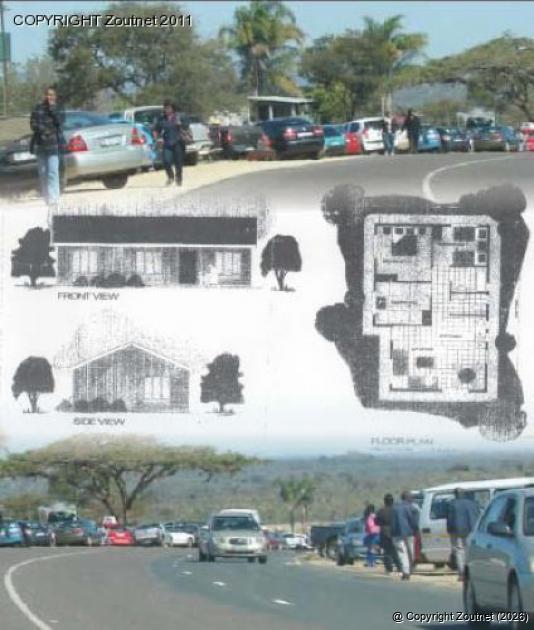
Hundreds flocked to stake their claim on a residential stand on the farm Welgevonden. This was the scene outside the farm gate on Tuesday. The Netshifhefhes´ planned township development (inset: floor plan of the houses to be built) on the repossessed farm has sparked widespread controversy. Photo supplied.
Farm to be turned into township?
News Date: 05 August 2011
A local community’s drive to develop a township on a piece of repossessed agricultural farm just outside of Louis Trichardt has raised a lot of eyebrows and once again put the spotlight on the controversial issue of land reform in South Africa.
During the past week, the Netshifhefhe community started taking deposits for stands on the farm Welgevonden 4LT (portion 27) with the aim of developing a township. The farm, about 15km from Louis Trichardt on the Thohoyandou road, was handed back to the Netshifhefhe community earlier this year after a successful land claim under the Mahoba Claim. As far as could be established, the Netshifhefhe community plans to erect between 2 000 and 4 000 houses on the farm. Previously, that farm boasted a productive chicken business, well-known to residents as Baron’s Chickens.
An “open day” was held on the farm on Tuesday, August 2, during which prospective home owners could come and stake their claim on a stand. Hundreds came, paying a R120 deposit (R100 for deforestation and R20 for transport).
The process sparked widespread concern, especially among members of the commercial farming community, who argued that this is yet again a prime example of where the South African government, through its land reform policy, has managed to destroy productive agricultural land at the cost of food security.
Asked to respond to the issue of claimants starting township developments on repossessed agricultural farms, the Acting Chief Land Claims Commissioner, Mr Tele Maphoto, basically washed his hands of the matter. Maphoto said on Tuesday that he was aware of what was happening on the farm, but that there was nothing the Land Claims Commission could do about it.
“With the issue of land use, you must deal with the local municipality, (asking) whether they did get permission for such land use,” Maphoto said, explaining that the Land Claims Commission does not engage in issues of land usage after a claim is finalised. “We have bought the land. We need to support them when they need to do agricultural activities, so if they don’t do agricultural activities, we can’t build them houses,” Maphoto said.
The selling of stands for a residential development on an agricultural farm also raised eyebrows with regard to whether or not the proposed development was advertised, the property was rezoned and whether or not an environmental impact assessment (EIA) was conducted.
Makhado municipal spokesperson Mr Louis Bobodi confirmed on Wednesday that they were aware of the situation on the farm and that the municipality and the Netshifhefhe community were engaged in discussions regarding the issue. He said the municipality was also aware of the fact that the Netshifhefhe community was in the process of trying to get the farm rezoned from agricultural to residential.
“We want to put it on record, however, that the municipality does not condone what is happening on the farm,” Bobodi said, indicating that the municipality is opposing the planned development, although people started paying deposits on stands. “Money or no money, the stance of the municipality is that the specific area is for agricultural use only, not residential,” Bobodi said. He also stated that, should discussions fail, the municipality would go to the next level of involving other departments and stakeholders, “but not excluding the Netshifhefhe community."
It is also clear through Bobodi’s response that no EIA had been conducted. “If there was, the municipality would have known about it as the municipality is part and parcel of the process,” Bobodi said.
From organised agriculture’s side, the Soutpansberg District Agricultural Union (SDAU) expressed their shock at what the Netshifhefhe community was trying to accomplish. “The subdivision of agricultural land and applications for township establishment must be done according to strict legislative processes. It is unacceptable that a person or community can be allowed to put out and sell stands without any impact study or application with regard to the relevant legislation,” says the SDAU in a media statement.
Mr Frits Ahrens, chairperson of the Louis Trichardt Farmer’s Association, also expressed shock with regard to the Land Claims Commissioners “irresponsible” reaction. “The commissioner basically said that they bought the land for the community and they are now free to do with it what they want. It is the same recipe that was directly responsible for the collapse of so many so-called land reform farms,” Ahrens said.
At the time of going to press, a response from the Ramabulana Royal Council, the authority over the Netshifhefhe community, was being awaited. Several phone calls were made over a period of two days during which we were told to phone back at later stages for comment. By Wednesday, phone calls were not answered.
Written by
Andries van Zyl
Andries joined the Zoutpansberger and Limpopo Mirror in April 1993 as a darkroom assistant. Within a couple of months he moved over to the production side of the newspaper and eventually doubled as a reporter. In 1995 he left the newspaper group and travelled overseas for a couple of months. In 1996, Andries rejoined the Zoutpansberger as a reporter. In August 2002, he was appointed as News Editor of the Zoutpansberger, a position he holds until today.

ADVERTISEMENT: