

ADVERTISEMENT:
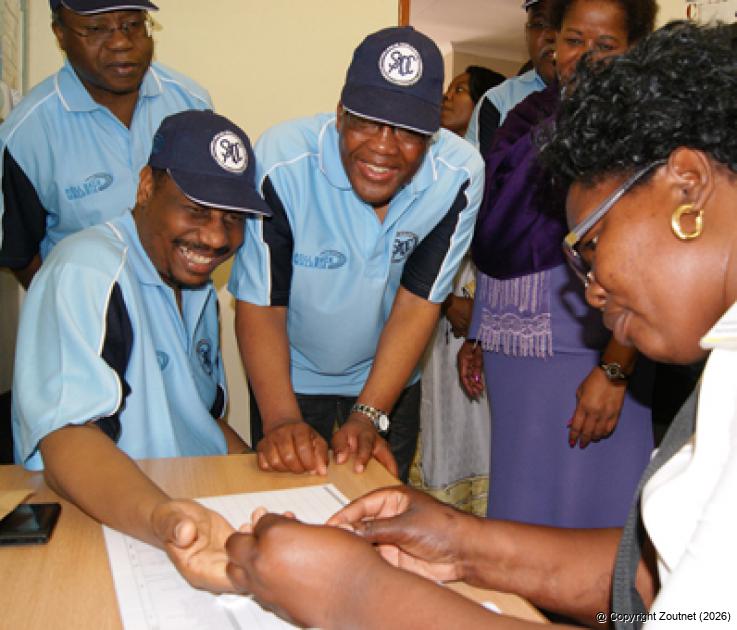
The Mozambican health minister Alexandre Manguele takes a malaria test while Min Aaron Motsoaledi (centre) looks on. The photograph was taken during the International Malaria Day event held at Bungeni last Friday. Behind them is the SADC deputy secretary, Mr Joao Samuel Caholo.
"SADC to continue using DDT to fight malaria" - Motswaledi
News Date: 21 November 2011
The use of Dichloro-Diphenyl-Trichloroethane, well known as “DDT” by African countries to fight mosquitoes, is not avoidable, according to the country’s Health Minster, Dr Aaron Motsoaledi.
He said that SADC had been very successful in fighting malaria. "We have cross-border cooperation and we are doing very well in the fight against malaria," he said. Motswaledi added that mosquitos do not have boundries and therefore, if the countries do not work together, they will have problems.
The minister was speaking during the International Malaria Day Celebration that was held at Bungeni village in the Makhado Municipal area. It was also attended by health ministers from the SADC region.
Environmental groups argued that DDT is a persistent organic pollutant, which can last between 2 to 15years in the soil, with a harming effect to the organisms living in it. When asked why African countries continued using the substance, despite the consequences, Motsoaledi said, “We’ve agreed as leaders in the whole of Africa not only in SADC, but at an AU meeting in Namibia, that we have to continue using DDT. If we stop using it, many people may die."
"The controversial arguments of what the DDT can do to the environment have been there since the 1960s, at the time when the DDT was first used. Most of the environmental groups that are arguing like that are from western countries," Motsoaledi added
He went on and said that the West, Europe and America used DDT to eliminate malaria in their countries. "They no longer have the outbreak because of the DDT substance. Now they’re telling us that we cannot use the same substance, because it’s supposed to be having some environmental defects in future, as they now call it. But for the past six years, nobody has been able to show us what is wrong with DDT,” said Motswaledi.
“I can show you million graves of malaria, but nobody has shown me a single grave caused by DDT. Those are the facts. We’ve debated this issue even within the world organisation and they have allowed us to use it. Therefore, we’re not going against any law,” he continued.
Written by
Peter Muthambi
Peter Muthambi graduated from the University of Venda with a Bachelor of Arts degree in Media Studies. He started writing stories for Limpopo Mirror as well as national papers in 2006. He loves investigative journalism and is also a very keen photographer.

ADVERTISEMENT: