

ADVERTISEMENT:
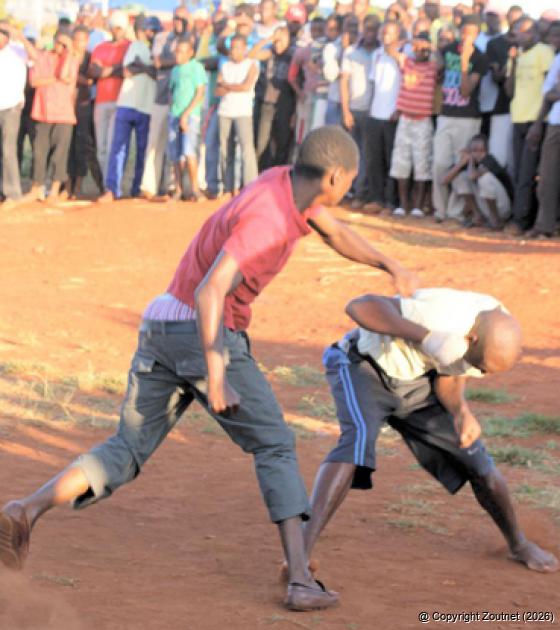
Feel it, it is here. Young men exchange blows during one of the fights.
Musangwe, a weapon in the fight against crime.
Sport Date: 30 March 2012
In the olden days, bare-knuckle fist fighting (musangwe) was a sport to test the strength and maturity of men. It was also used as a pastime while men were in the veld herding livestock.
The same sport has become a powerful tool today to fight crime in the community. One such community is the Matatshe-Makhuvha community. During weekends and holidays, all the boys of school-going age gather at a spot at the junction to Donald Fraser and Makonde.
During the recent Human Rights Day, Limpopo Mirror was part of the proceedings. The attendance was very high, with spectators cheering from the first whistle till the last fight. A mbira player was moving around among the spectators, playing his cultural instrument. “This is to incite prospective fighters. It is used every time this type of fight takes place. This instrument revives the energy in a person and makes him ready for a fight,” said the man who was playing but did not want his name published.
The coordinator of the sport in the village, Mr Rampfumedzi Masikhwa, a boxing trainer at the Thohoyandou Boxing Club, said the idea of traditional boxing came about as a result of crime taking place in the area. "We all know that boys are naughty. If they do not have anything to do, they might turn to some silly things that could land them in jail. To avoid this, we have to do something that can keep them busy. Musangwe is one of those activities that could do the trick,” he said.
As a boxing trainer himself, he says that the sport has become a launch pad for the village’s youths to launch their boxing careers. “There is a lot of talent around here. The talent only needs to be nurtured and exposed, and so far we have been able to identify some of them. We are busy training them to be future boxing champions,” he said.
Bishop Wilson Netshivhera, one of the organisers, said there was more to musangwe than met the eye. “This is a sport that teaches respect among men. Boys are prepared for their future roles here and we are also ensuring that the sport and our culture do not fade away,” he said.
He said they would want to see the sport grow, but they did not have the resources to promote the sport. “This sport is loved by Africans. People in the cities like it, but they cannot afford to be here all the time. If we had the means, we would take this sport to the people even in far-away places,” he said.
The sport is run under strict supervision of the elders.
Written by
Elmon Tshikhudo
Elmon Tshikhudo started off as a photographer. He developed an interest in writing and started submitting articles to local as well as national publications. He became part of the Limpopo Mirror family in 2005 and was a permanent part of the news team until 2019. He currently writes on a freelance basis, covering human rights issues, court news and entertainment.

ADVERTISEMENT: